
ThreatFabric announces Agentic AI Risk and Know Your Agent (KYA)
19 November 2026
Agentic AI is no longer theoretical.
It is happening now:
- Google has announced the beta of its on-device AppFunctions framework for Android, alongside Computer Control for UI-based automation. AI agents are becoming a native part of the mobile ecosystem.
- ThreatFabric has identified more than ten different AI agent apps on devices running our customers’ banking apps. Most were installed from outside Google Play and use Android Accessibility Services to read the screen and interact with apps on the user’s behalf, using techniques similar to those seen in banking malware.
- AI is also changing the economics of fraud. According to Interpol, AI-enhanced fraud is 4.5 times more profitable for criminals.
That’s why ThreatFabric now supports Agentic AI Risk and Know Your Agent (KYA): distinguishing humans from AI agents, legitimate agents from malicious ones, and a new AI model to differentiate good intent from bad, across mobile and web channels.
Agentic AI risk is about more than detecting whether an agent is present.
A legitimate agent can be hijacked, manipulated or instructed to perform a malicious action. A “good” agent does not necessarily mean that what it is doing is good. Banks therefore need to understand not only the agent’s identity, but also its behaviour, context and intent.
This puts device, behaviour and session intelligence at the centre of Agentic AI fraud prevention. An agent can claim to be anything; the device it runs on, the session it creates and the way it behaves reveal what it really is and what it is trying to do. ThreatFabric uniquely brings these three perspectives together, combining device intelligence, behavioural analytics and session monitoring to assess agentic risk throughout the digital banking journey, before the transaction.
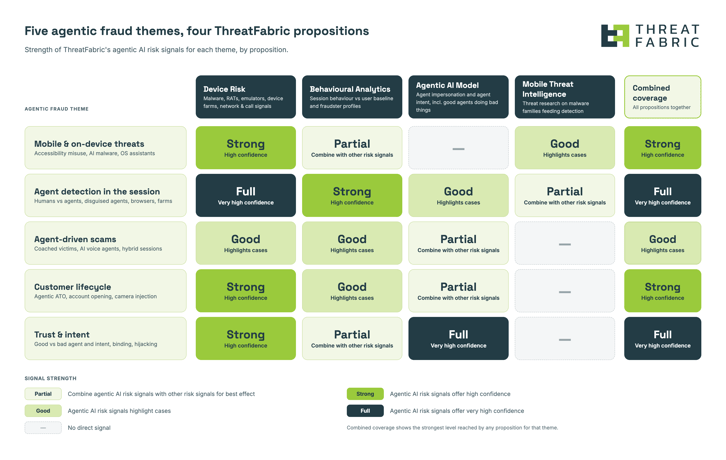
ThreatFabric’s existing capabilities already address five critical themes of Agentic AI risk:
- Mobile & on-device threats: Accessibility Service misuse, AI-enabled malware and device takeover, and assistants operating banking apps.
- Agent detection in the session: humans vs agents vs bots, agents disguising themselves as humans, agentic browsers, cloud-hosted agents and agent farms.
- Agent-driven scams: coached victims, AI voice agents operating during the session, and hybrid agent-human attacks.
- Customer lifecycle: agentic account takeover and account opening at scale.
- Trust & intent: good agent vs bad agent, good intent vs bad intent, agent-to-user binding, hijacked agents, and legitimate agents being used to carry out malicious actions.
Agentic fraud is only beginning to emerge, and its attack patterns will continue to evolve. ThreatFabric’s Agentic AI Risk capabilities will evolve with them, building on our existing device, behaviour and session intelligence to identify new agentic threats and help financial institutions distinguish trusted automation from fraud and abuse.